Delegation and Mesnada Configuration
Keys of the Mesnada orchestrator and of delegated-task handling, plus the tools the agent uses to delegate. For the idea, read Agent delegation; for the walkthrough, the guide Delegate to subagents with Mesnada.
Web UI: Settings > Mesnada (server, orchestrator, ACP) and Settings > General > Subagent Delegation.
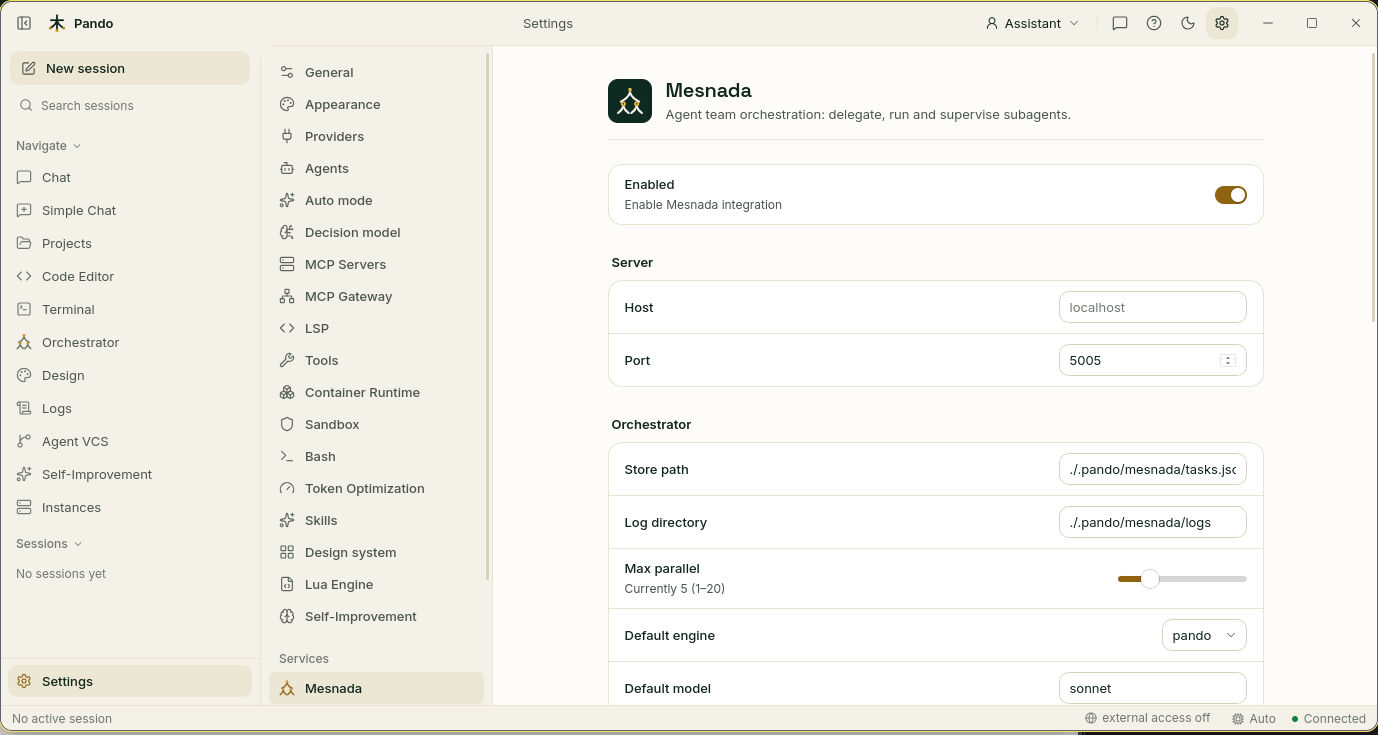
Orchestrator
[Mesnada]
Enabled = true

[Mesnada.Server]
Host = 'localhost'
Port = 5005

[Mesnada.Orchestrator]
StorePath        = './.pando/mesnada/tasks.json'
LogDir           = './.pando/mesnada/logs'
EnginesDir       = ''        # defaults to <dirname(LogDir)>/engines
MaxParallel      = 5         # tasks in flight at once; 0 = unlimited
MaxPerEngine     = 0         # per-engine cap; 0 = unlimited
ClaimTTL         = '2m'      # how long a dispatch reservation lasts
DispatchInterval = '10s'     # how often deferred tasks are started
DefaultEngine    = 'pando'
DefaultModel     = ''
PersonaPath = ''| Key | Web UI label | Description |
|---|---|---|
MaxParallel | Max parallel / Max parallel tasks | Tasks over the cap wait and start as slots free up |
MaxPerEngine | Max tasks per engine (0 = no limit) | Keeps one engine from using every slot |
ClaimTTL | Dispatch claim TTL | A reservation that expires without the task starting is reclaimed |
DispatchInterval | Dispatch interval | Go duration string |
DefaultEngine | Default engine | pando, claude, copilot, openai, google, ollama or a custom engine |
DefaultModel | Default model | Used when a task names none |
PersonaPath | Persona path | Folder with persona files |
Custom engines
Place *.template.yaml files in EnginesDir. Each template specifies command, args (with Go template expressions), prompt mode, output format and available models. Custom engines appear dynamically in the mesnada_spawn_agent tool.
Delegation
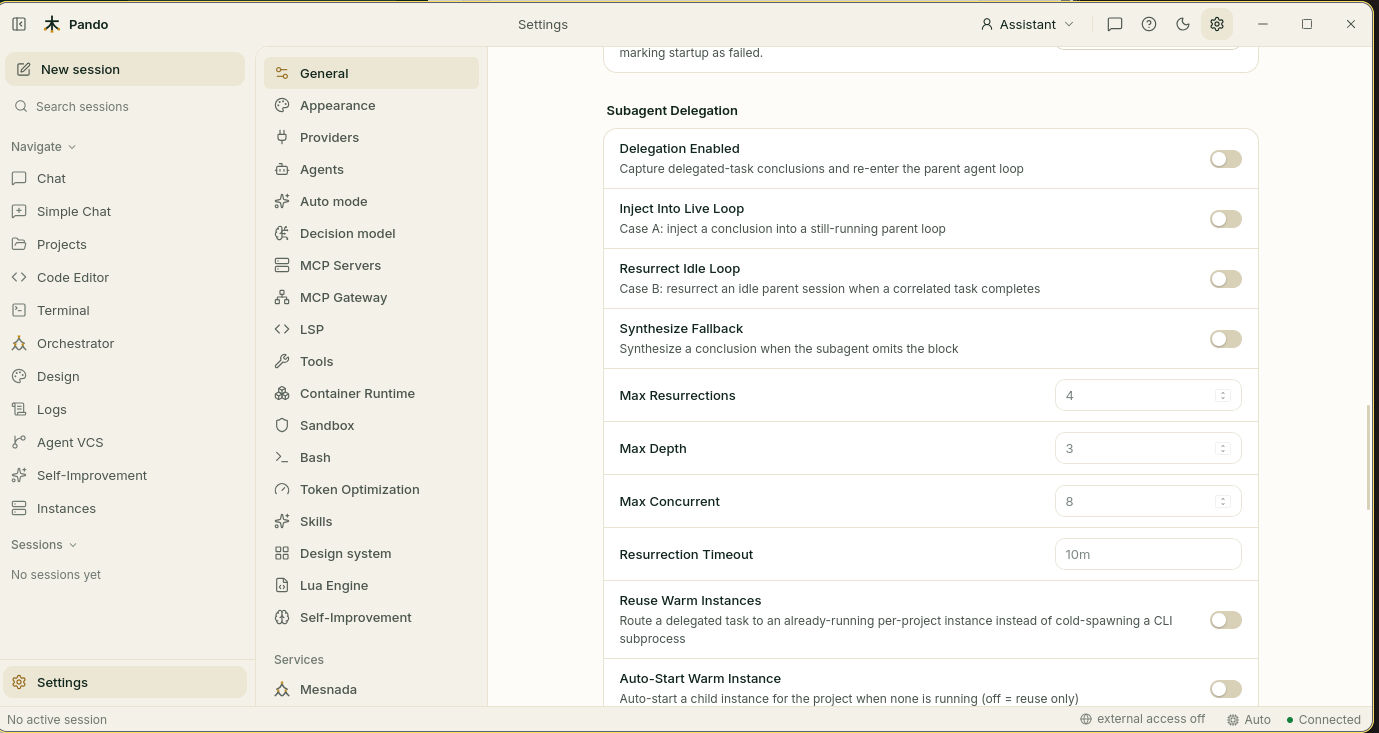
[Mesnada.Delegation]
Enabled             = true
InjectIntoLiveLoop  = true
ResurrectIdleLoop   = true
SynthesizeFallback  = false
MaxResurrections    = 4
MaxDepth            = 3
MaxConcurrent       = 8
ResurrectionTimeout = '10m'| Key | Default | Web UI label | Description |
|---|---|---|---|
Enabled | false | Delegation Enabled | Capture delegated-task conclusions and re-enter the parent agent loop |
InjectIntoLiveLoop | false | Inject Into Live Loop | Hand a conclusion to a parent that is still running |
ResurrectIdleLoop | false | Resurrect Idle Loop | Wake an idle parent session when a related task completes |
SynthesizeFallback | false | Synthesize Fallback | Write a conclusion when the subagent omits it |
MaxResurrections | 4 | Max Resurrections | Wake-ups allowed per session and chain of turns |
MaxDepth | 3 | Max Depth | Levels of subagents of subagents |
MaxConcurrent | 8 | Max Concurrent | Outstanding tasks per parent, and sessions routed to one warm instance |
ResurrectionTimeout | 10m | Resurrection Timeout | How long to wait for sibling conclusions still pending |
Warm instances and other projects
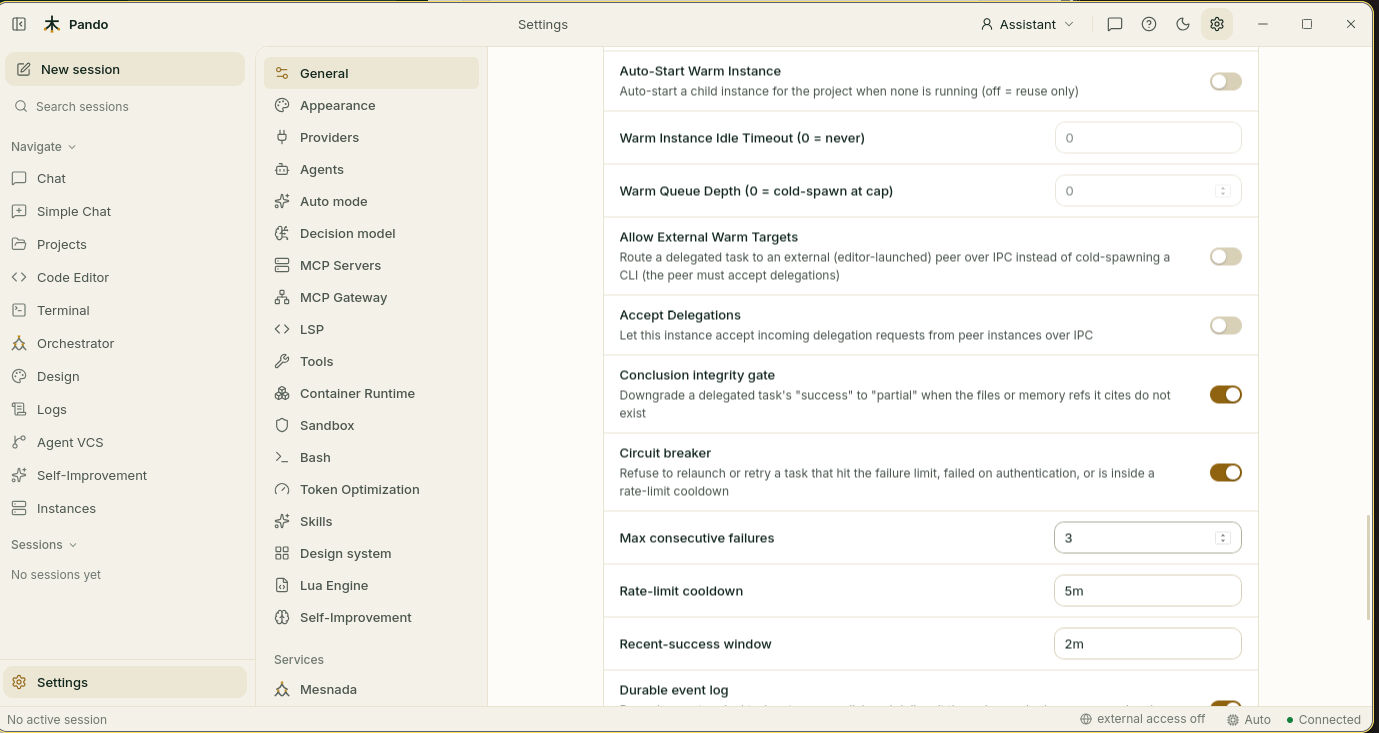
[Mesnada.Delegation]
ReuseWarmInstances       = true
AutoStartWarmInstance    = true
WarmInstanceIdleTimeout  = '10m'   # '0' or empty = never stop it
WarmQueueDepth           = 0       # 0 = start a separate process when the instance is full
AllowExternalWarmTargets = true    # caller side
AcceptDelegations = true # target side| Key | Web UI label | Description |
|---|---|---|
ReuseWarmInstances | Reuse Warm Instances | Route a delegated task to the already-running instance of its project. Requires Enabled |
AutoStartWarmInstance | Auto-Start Warm Instance | Start an instance for the project when none is running (off = reuse only) |
WarmInstanceIdleTimeout | Warm Instance Idle Timeout (0 = never) | Stop an auto-started instance after this long without delegated work |
WarmQueueDepth | Warm Queue Depth (0 = cold-spawn at cap) | Tasks that may wait for a slot in a full instance |
AllowExternalWarmTargets | Allow External Warm Targets | Send a task to an instance launched by an editor, over IPC. The target must accept delegations |
AcceptDelegations | Accept Delegations | Let this instance run tasks sent by peer instances |
The project parameter of mesnada_spawn_agent routes the task to the right project’s instance.
Safety nets
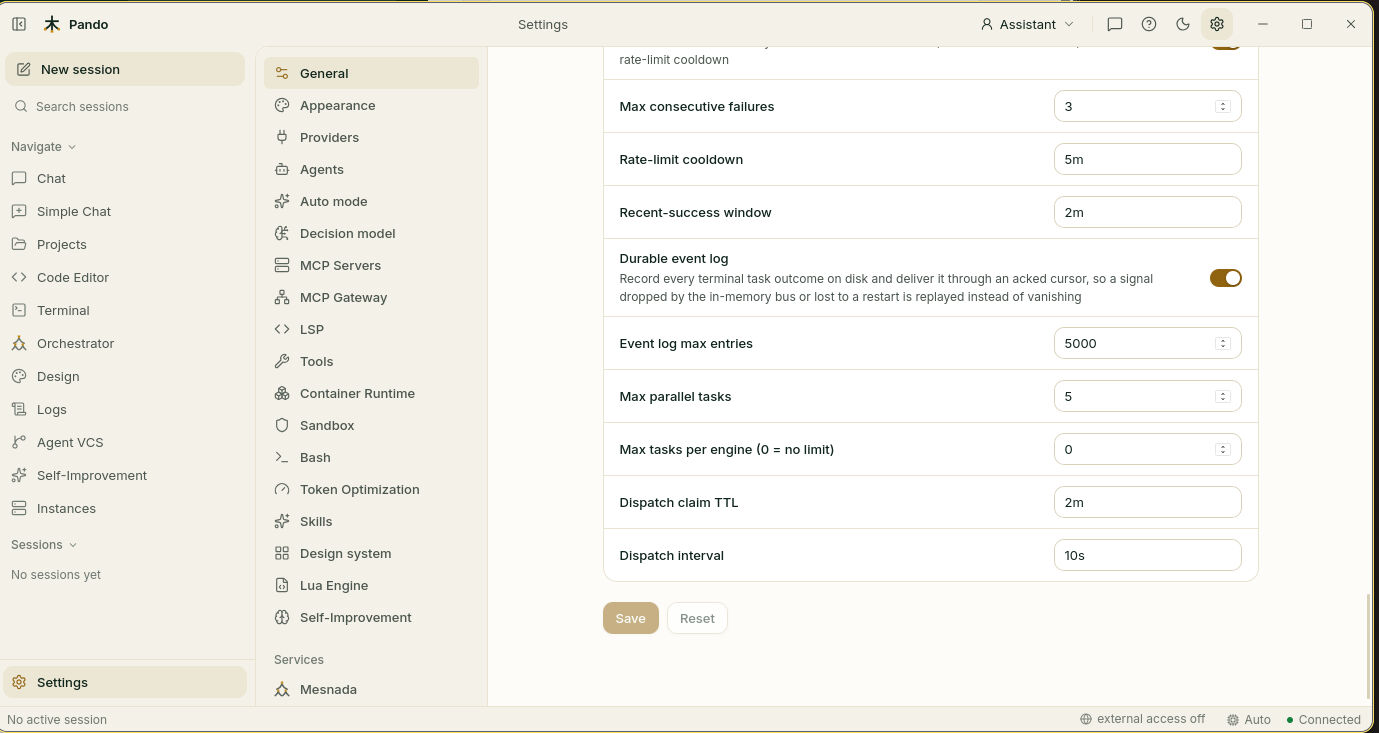
| Key | Default | Web UI label | Description |
|---|---|---|---|
ConclusionGateDisabled | false | Conclusion integrity gate (on) | The gate downgrades “success” to “partial” when the files or memory references cited do not exist |
BreakerDisabled | false | Circuit breaker (on) | Refuses to relaunch a task that reached the failure limit, failed on authentication or is inside a rate-limit cooldown |
MaxTaskRetries | 3 | Max consecutive failures | Reset by any success |
RateLimitCooldown | 5m | Rate-limit cooldown | Wait after a rate-limit failure |
RecentSuccessWindow | 2m | Recent-success window | Re-running a task that just succeeded is refused within this window |
EventLogDisabled | false | Durable event log (on) | Every final task outcome is written to disk and delivered even after a restart |
EventLogMaxEntries | 5000 | Event log max entries | Older events are compacted away |
BlackboardMaxEntriesPerSwarm | 200 | Size limit of a swarm’s shared notes | |
BlackboardTTL | 168h | A finished swarm’s shared notes are purged after this long |
Tools the agent uses
mesnada_spawn_agent launches a task:
{
  "prompt": "Analyze the authentication module and write tests",
  "subagent_type": "general",
  "description": "Write auth tests",
  "background": true
}| Parameter | Description |
|---|---|
prompt | The instruction for the spawned task |
subagent_type | explore (read-only) or general (full capabilities) |
background | true to keep going without waiting, false to block until completion |
project | Target a registered project by id, name, or path |
engine | CLI engine: pando, copilot, claude, gemini, etc. |
model | Override the model for this task |
dependencies | List of task IDs that must complete first |
task_id | Relaunch an existing task in-place |
Dependencies, with the logs of the earlier tasks passed along:
{
  "prompt": "Write tests based on the analysis",
  "dependencies": ["T1", "T2"],
  "include_dependency_logs": true,
  "dependency_log_lines": 100
}
Waiting without blocking (recommended) uses mesnada_await; the parent agent is resumed when results arrive:
{
  "action": "wait",
  "actor_id": "explore-1"
}
Blocking until one task completes uses mesnada_wait_task:
{
  "task_id": "T1",
  "timeout": "10m"
}| Tool | Purpose |
|---|---|
mesnada_get_task | Get task details |
mesnada_list_tasks | List tasks with filters |
mesnada_cancel_task | Cancel a task |
mesnada_get_task_output | Get stdout/stderr |
Agent self-service (pando_setup)
The built-in pando_setup tool needs no configuration and is always available to the agent. See Agent Self-Service.
| Command | Purpose |
|---|---|
help | List available commands or get usage for a specific one |
config | Read the active configuration (read-only, same view as TUI/WebUI settings) |
providers | List configured provider accounts with types, credentials, and model counts |
models | Browse available models with context window, pricing, and capabilities |
session | Check last turn’s token usage and accumulated session cost |
commands | List available slash commands |
run <command> | Activate a slash command for the current session |
pando_setup models --provider anthropic --detail --limit 5
pando_setup providers
pando_setup config                           # show all config
pando_setup config --search token            # search for token-related settings
pando_setup config TokenOptimization         # show a specific section
pando_setup run /caveman lite
pando_setup session
models uses the live model registry, enriched with models.dev: canonical ID (for example copilot.gpt-5.4), context window, price per million tokens, capabilities and knowledge cutoff.
Commands the agent may run with run:
- Mode commands:
/caveman,/caveman-finish,/ponytail,/ponytail-finish,/superpowers,/superpowers-finish,/learning,/learning-finish. - Instruction commands:
/improve-agents-md,/vulnhunt,/vulnhunter-fix,/vulnhunt-fix-verify, and customuser:andproject:commands.
Blocked, because they need you at the controls: /goal*, /compact, /db-compact and all -finish closing commands.
Security: configuration is strictly read-only (no write path exists); secrets are masked by key suffix (apikey, token, password, secret…) showing only the last 4 characters; the tool description stays under 600 characters; the tool cannot be trimmed away by context optimization.